What Emotional Safety *Really* Means in a Relationship
Dec 22, 2025
By GGC Clinician Liz Bohnsak
What Emotional Safety Really Means in a Relationship
Maybe you’ve felt it: the pit in your stomach before you speak up, the overthinking after you share something vulnerable, the fear you’ll be “too much,” pushing down difficult thoughts or feelings to “keep the peace.” These are all examples of how our body and mind react when we lack emotional safety in a relationship. Emotional safety is being able to show your most authentic self without risking rejection, shame or abandonment. It is the quiet permission to be exactly who you are, flaws and all, and still be seen, heard, and returned to.
Why emotional safety matters (short answer: everything)
The human nervous system has evolved over the years but the main job remains the same which is to keep us safe and survive. When we feel safe, we can connect, think clearly, and heal. When we feel emotionally unsafe, we feel emotionally threatened which elicits the same response as a physical threat. Our nervous system automatically shifts us into protection mode: fight, flight, freeze, or shutdown. Neuroscience research shows that when we feel rejected or shut out socially, the brain reacts in much the same way it does when we experience physical pain — the same neural regions light up. In other words, our brains interpret emotional wounds and physical injuries as almost identical threats. And when we don’t regain a sense of safety and belonging soon after, our nervous system can stay stuck in a “danger” state, like we’re constantly bracing for harm. CP
Repeated experiences of emotional insecurity, such as enduring abusive relationships, being subjected to bullying, or unmet emotional needs during childhood, can leave profound and lasting scars. These emotional wounds may persist over time and are often easily triggered by situations or people that feel reminiscent of past pain. The effects of these experiences can influence how a person reacts within current relationships, shaping their ability to trust and feel safe. Recognizing your own patterns is essential for the work needed to heal and foster connection.
What emotional safety looks like in real life
Emotional safety is built through consistent, everyday moments where connection outweighs fear.
- You can express a feeling without being punished for having it. Instead of hearing, “You’re overreacting,” you hear, “Thank you for telling me. I want to understand.”
- You don’t have to always rehearse your words before you speak. You know that even if it comes out messy, the relationship can handle the real version of you, not just the polished one.
- Disagreements aren’t threats. The conversation might be hard, but it stays respectful. The other person doesn’t shut down, explode, or turn your vulnerability against you.
- Repair is normal. When something goes wrong, it’s acknowledged and addressed. It sounds like, “I see how that hurt you. I’m sorry. How can we do this differently next time?”
- You feel with them, not against them. There is a sense of being on the same team, shifting from defense to collaboration.
- Your nervous system relaxes. Your shoulders soften. You breathe more easily. Your body stops bracing and starts trusting.
Over time, these practices teach the nervous system that the relationship is a safe place. Repeated repair and attunement becomes the relationship’s secure base — the place you can come back to when life is hard.
Emotional safety also isn’t just a romantic relationship concept. It is just as essential in friendships, family dynamics, and other everyday connections. In non-romantic relationships, emotional safety looks like friends who respect your boundaries instead of pressuring you, siblings who apologize instead of holding grudges, and parents or mentors who listen with curiosity rather than criticism. Safe relationships create room for disagreements without fear of abandonment, space for honest conversations without shame, and trust that you won’t be talked about behind your back. When emotional safety is present, we feel stable enough to grow. When emotional safety is missing, we shrink, mask, or disconnect. In every type of relationship, emotional safety is the foundation that makes vulnerability possible and connection sustainable. This isn’t because people never mess up or ruptures never happen, but because they care enough about the relationship to take responsibility and consistently come back to repair.
How therapists build emotional safety and why it’s different from “fixing” you
Therapy is a laboratory for emotional safety. Here are three mechanisms therapists use (and how they translate to everyday relationships):
- Attunement and validation. Therapists model what it feels like to be heard without being judged. This is the first lesson for many clients: your feelings make sense and they don’t make you broken. Research on the therapeutic alliance shows that the quality of the relationship itself is one of the strongest predictors of positive outcomes across therapy types. That therapeutic connection lays the groundwork for risk-taking and growth. PubMed+1
- Rupture-and-repair practice. No relationship is rupture-free. The difference is how ruptures are handled. In skilled therapy, when a misunderstanding or boundary is crossed, the therapist helps name it, invites repair, and models how to make amends. Studies on alliance ruptures find that recognizing and repairing ruptures is associated with better outcomes — the repair itself is often transformative. Learning this move in therapy helps you bring it into family and romantic relationships. PubMed+1
- Skills + nervous-system work. Therapy blends practical skills (assertive communication, boundary setting) with work that targets the nervous system. Common psychological theories and approaches that work with the nervous system are EMDR (Eye Movement Desensitization and Reprocessing) for trauma memory processing, IFS (Internal Family Systems) to compassionately unblend from protective parts, EFT (Emotionally Focused Therapy) to focus on emotional connection and attachment, Polyvagal and somatic practices that focus on the mind body connection. (Grace & Gratitude even offers IFS-informed EMDR intensives for deeper processing — approaches that create safety inside the client so they can show up more safely in relationships. Check them out on our website!)
Bringing emotional safety into your everyday relationships
You don’t have to wait for the “perfect” moment. Here are tangible, clinically informed steps you can use today:
- Name the need, not the blame. Try “I notice when X happens I feel Y and I’m afraid of Z,” rather than “You always…” Naming the felt need invites connection.
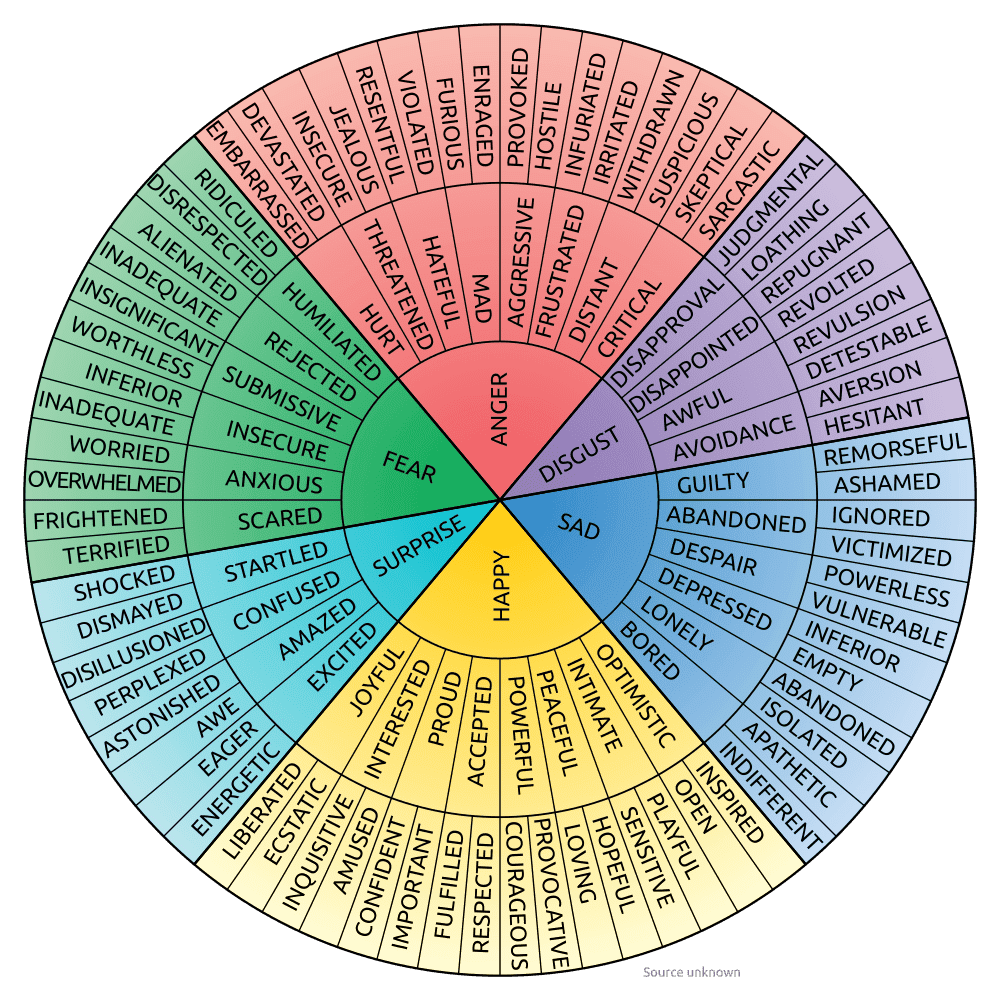
- Identify and name your emotions. Grab a feelings wheel like the one below and get familiar with identifying specific emotions. (This is especially important for teens to be able to communicate their feelings so the adults in their life can respond to the emotion before the behavior.)
- Mirror back the feeling, not a solution. “You sound really hurt.” “I can see how frustrating this is for you.”
- Listen twice as much as you talk. A reminder that all of us want to be seen, heard, and understood. Active listening is a powerful tool of attunement and connection.
- Practice curiosity before conclusion. When a defensive urge strikes (because we all have those urges), ask a question such as, “Help me understand what you meant.” Curiosity lowers the threat.
- Use co-regulation tools. Slow breathing, brief grounding, or a 60-second pause before responding can change the trajectory of a fight. These aren’t tricks — they alter your nervous system’s response. (Polyvagal-informed clinicians often teach co-regulation as a concrete bridge to safety.) PMC
- Focus on small repairs. Repairs don’t need to be large scale. A short apology and a clear next step are powerful.
When to bring therapy into this work
If trying these steps leaves you feeling stuck, chronically anxious in relationships, or triggered by past hurts, therapy can speed up progress and keep you safe while you learn. Because therapists are trained to notice rupture patterns, gently challenge protective defenses, and provide reparative experiences, therapy often helps clients build relational habits they can use outside the room. The research is clear: attachment-focused work and a strong therapeutic alliance are powerful engines of change. Ovid+1 Safety is teachable. Repair is learnable. Healing is possible. The therapists at Grace and Gratitude are passionate about walking alongside our clients through that journey.
Selected sources and further reading
- Sue Johnson, Hold Me Tight: Seven Conversations for a Lifetime of Love. (On how disconnection underlies many fights.) Psychology Today
- Michelle Quirk, Emotional Safety: What It Is and Why It’s Important.
- Porges, S. W., “Polyvagal Theory: A Science of Safety.” (Discusses neurophysiology of safety and social engagement.) PMC
- Eisenberger, N. I., & Lieberman, M. D. (2004). Why rejection hurts: The neurocognitive overlap between physical and social pain. Trends in Cognitive Sciences, 8(7), 294–300. (Why ruptures in emotional safety can feel painful.) CP
- Flückiger, C., Horvath, A. O., et al., (2018) “The Alliance in Adult Psychotherapy: A Meta-Analytic Synthesis.” (Alliance predicts outcomes across therapies.) PubMed
- Safran, J. D., & Muran, J. C., (2011) “Repairing Alliance Ruptures” and related meta-analyses on rupture/repair. (Why repair matters.) PubMed+1
Podolan, M. & Gelo, O.C.G, (2023) “The Functions of Safety in Psychotherapy: An Integrative Theoretical Perspective Across Therapeutic Schools.” PMC
SCHEDULE YOUR FREE 20-MINUTE CONSULTATION
Let's chat! You've been looking for a counselor who specializes in exactly the stuff you're going through, and we want to make sure you get what you need. So, we offer a free consultation in which you can ask questions and feel 100% comfortable before moving forward with a therapist that matches your needs.
Ready to get started?
Get the Latest GGC News to Your Inbox
Subscribe to our newsletter to receive news and updates about counseling groups, workshops, self-help strategies, and more!